.png)
Solar Becomes the Fastest-Growing Energy Source.

Last month the International Energy Agency (IEA) published their flagship Global Energy Review 2026. Among various positive trends in renewables uptake and fossil fuel phase-out, the standout findings relate to the rapid growth of solar energy in 2025.
Last year, the global demand for energy grew by 1.3%, slightly lower than the decade average. Of this added demand, nearly 60% was met by low emissions sources: solar, wind, hydropower and nuclear. In particular, solar saw the largest single source of growth, and met more than 25% of new demand globally. This points to two positive findings: energy demand is slowing down, and solar is scaling up fast.
These findings show that solar energy deployment is on track to meet its deployment targets to reach net zero by 2050 and limit global warming to 1.5°C. By harnessing positive tipping points, such as falling costs and behavioural change, solar could be scaled across industries.
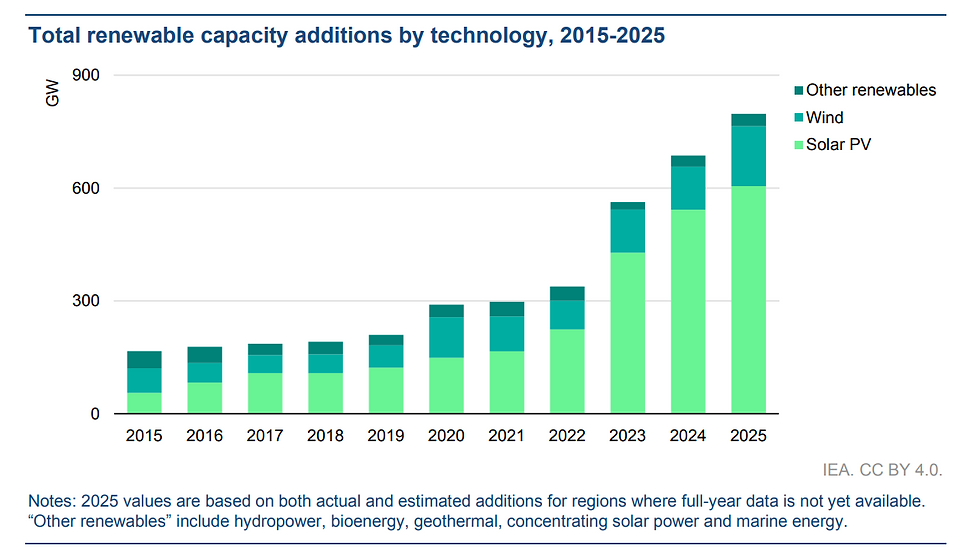
Figure 1: Graph showing the significant increase in solar PV capacity in the last decade. Source: IEA
What Has Led to this Increase?
Positive social tipping points occur when small changes begin to accelerate wider shifts towards sustainability. Once new solutions pass a certain threshold, they become cheaper and information becomes more widely available. With solar energy, a better understanding of the technology needed for energy storage and grid connection has sped up the process. This has lowered costs and the logistics of solar roll out - from national plans to household solar panels.
This spike has also been part of a broader trend towards electrification. Electric vehicles and electrified heating and appliances have pushed demand for electricity up in recent years. However, the trend can still improve – for instance, in the European Union, electricity represents only 23% of final energy consumption. In their Electrification Action Plan they set 32% by 2030 as the next reference – meaning there is still a gap to fill before meeting their electrification targets.
The overall trend should still be celebrated as a positive development in the low carbon energy landscape. Influenced not only by decreasing prices, improved technologies and clear political will, the trend is now also reinforced by the renewed focus on energy security. Geopolitical shocks like the invasions of Ukraine and Iran have led to huge spikes in oil and gas prices in recent years – making fossil fuels less economically viable compared to some of their low carbon counterparts. Renewable power generated domestically creates more stability and energy independence allowing countries previously dependent on fossil fuels imports to achieve energy security and affordability.
The Case of the UK.
Following the war in Iran, the UK Government wants to “embrace the solar revolution” to help reach clean energy goals and reduce dependence on volatile international markets. March 2026 saw 27,000 solar installations completed, the highest monthly rollout in over a decade. This was mostly made up of residential solar panels on houses, showing a clear change among consumers who want to have control over their energy production.
This huge increase in demand and roll out has led to more records being broken every week. At midday on April 23rd, an estimated 15,420 MW of solar PV power was online. This made up 42% of the UK's energy needs on this day, powering roughly 11 to 15 million homes. Despite the reputation for overcast weather, it is clear that solar power in the UK is efficient, reliable and on track for climate goals set out in the 2030 Action Plan.
Businesses and Solar Energy.
In the UK Government’s solar roadmap, independent research estimates that the solar industry could provide 35,000 jobs by 2030 – double the current figure. Clean energy transitions support skilled jobs across system design, installation, maintenance and manufacturing.
A key message from the International Energy Agency report and the IPCC Working group III is the need for business and industry to scale up as quickly as the domestic market. Adopting solar power will lower long-term energy costs and create resilience for future energy shocks or volatile markets. Within industry, there are new avenues for on-site energy generation and storage – as well as added revenue, thanks to the increasing opportunity to sell energy back to the grid. The UK Warehousing Association, for example, has reported that utilising just the largest 20% of UK warehouses – equivalent to 75 million square metres - for solar installation could double the country’s current solar PV capacity.
As well as intersecting economic and sustainability goals, this helps the UK to scale solar responsibly and may take pressure off arable farmland to provide optimal spaces for solar.
Scaling Responsibly.
Some tensions can emerge around solar, which is less about the technology and more about land use. New policy from the government requires developers to justify using any new land and design projects to mitigate or compensate for any impacts. There is some reluctance to use land which could one day be used as farmland, which is where rooftop solar panels offer alternatives.
Interestingly, new research commissioned by the RSPB has found that solar farms had higher numbers of bird species and abundance than arable farm fields, with higher numbers when solar management included the planting of local flowers and shrubs. Because solar panels are off the ground, they do not damage the ecosystem and actually give shade, perches and nest space for many bird species. There is also the option to combine solar panels with farming, a practice called agrivoltaics.
There can be multiple benefits to new energy systems, from affordability and energy security to biodiversity protection and nature-based solutions – a strong positive development as long as new proposals for solar power are collaborative and account for local community interests.
The Energy Transition.
The positive trend of solar energy uptake and development shows that rapid change is possible, especially when reinforcing factors combine. But progress can only be maintained and replicated in other sectors with strong cross-sector collaboration and partnerships. Solar has now become a viable option at the household, business and national level – prices continue to drop and the logistics of implementation are now easier to manage. To replicate that in other sectors and for other technologies or practices will require coordination across the value chain (design, specifications, offtakes, investment, insetting, bulk purchases…) and stakeholders (universities, startups, established businesses, policymakers, consumers).
Back to renewable energy, it is estimated that solar, wind and energy efficiency measures combined will deliver around half of all emissions reductions to 2030. While solar is ahead of projections, there is still work to be done for other technologies and energy efficiency. Efficiency measures like insulation, electrification and emissions audits in industry, buildings, appliances and transport can be put into effect and scaled up very quickly. This can be done to complement solar installations or as an extra step to keep energy costs down.
Call-to-action.
Businesses and organisations may lack the scale or expertise to transition alone. Associations can accelerate adoption through shared learning, frameworks, group purchasing, standards and cross-sector collaboration. They have a unique position to help shape the transition to low-carbon energy. By helping members understand new policy for solar through trusted guidance, associations can lead the new wave of solar roll out for industry and business. The information and technology are there, but the momentum can’t stop here, now is the time to support the deployment and uptake of solar – for your sector and for business longevity.
CAFA offers free access to resources, a best practice framework and dedicated experts to help your sector navigate the energy transition. Join our growing collective of organisations committed to strong climate leadership.


Comments