.png)
Reaching Net Zero by 2050 "cheaper than the cost of a single fossil fuel spike".
- 2 days ago
- 4 min read

According to a recent publication from the Climate Change Committee (CCC), reaching net zero by 2050 is cheaper than the cost of a single fossil fuel spike of the magnitude of 2022 caused by the Russia-Ukraine war.
This information comes in an addendum to the CCC’s Seventh Carbon Budget, and as the Iran war means consumers are dealing, once again, with increased oil and gas prices to levels not seen since 2022 peaks.
The turmoil in international energy markets over the last four years has demonstrated the threat posed by the UK’s fossil fuel dependence, as is further demonstrated by the Iran war. Achieving net zero requires a domestic energy supply which would make the UK less vulnerable to price shocks and geopolitical factors. With the efficiency gains of an electrified system and associated co-benefits, decarbonisation and net zero remain the most economically viable solution.
The Cost of Fossil Fuel Dependence
According to an E3G report on Cost of the fossil fuel crisis in the UK over the last four years, published in 2025, UK consumers have paid a total of £183 billion due to volatile energy market. Approximately 1/3 of costs are attributed towards: direct household costs, governmental direct support costs (in defending households and businesses from fossil fuel price volatility) and extra energy costs for businesses and other customers.
Short Term Impacts
Household gas costs remain 75% higher than before Russia’s invasion of Ukraine. The UK’s electricity generation is heavily dependent upon burning fossil gas (28.1% as of March 2026), which continues to set the price for electricity in Great Britain for the majority of the time. This results in UK electricity prices being amongst the highest of comparator nations. Business energy costs are, on average, 70% higher than pre-crisis rates, and expected to remain high for the foreseeable future.
Long Term Impacts
High energy prices mean that the wider economy suffers. Dramatic rises in business energy costs have decreased profitability since it’s not always possible to pass these costs down to their customers, who also are spending more on their own energy bills. This low profitability means lower industrial output and lower GDP: lower profit margins act as a barrier to growth, deterring investment and reducing business confidence. Reduced disposable income means lower household discretionary spending.
These additional, indirect costs are hard to measure, meaning that the estimated £183bn cost of the fossil fuel crisis so far is likely to be conservative.
The Cost and Benefit of Net Zero
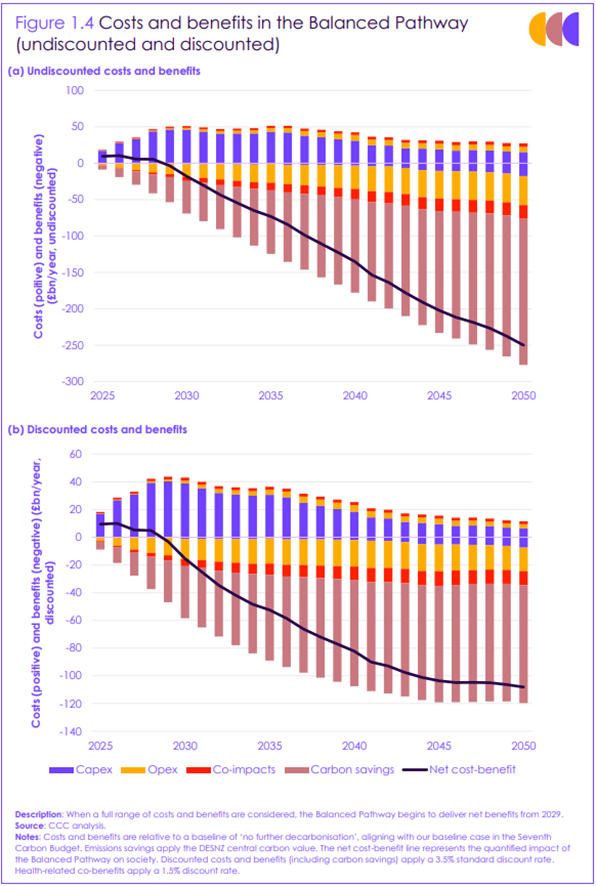
Net zero, through the CCC’s suggested Balanced Pathway, would cost £4bn a year (on average) between 2025 and 2050. This cost is relative to a baseline scenario of not pursuing net zero further, calculated as the total investment needed minus cost savings.
One source of cost saving is in efficiency gain in the transformation of raw resources to energy. Energy losses in today’s systems are valued at £60bn a year. These losses are primarily attributed to inefficient conversion in the burning of fossil fuels to produce energy. The fuel efficiency of a typical combined cycle gas powered station is 54%, whereas renewable sources - such as wind and solar - do not create this level of inefficiency and associated losses. This reduces energy expenditure by £30bn a year. A greater efficiency means less primary energy is needed to deliver the same service.
Further savings are also made at a smaller scale. Low carbon technologies are typically more efficient than their high-carbon counterparts. Electric vehicles (EVs) are 4 times more efficient that the typical petrol car, requiring 1/4 of the energy to travel a given distance. Heat pumps are 3-4 times more efficient than gas boilers.

Another saving is emissions. Climate change has an associated cost. According to the CCC’s report, climate change damages in the UK could reach 2-4% of GDP under a 2ºC global warming level by 2050, and as high as 4-10% under a 4ºC level by 2100 (as compared with 10-23% decline in global annual GDP by 2100).
Co-benefits such as cleaner air, and greater health and well-being (read more in CCC’s report) are estimated to provide £2-8bn net benefits by 2050.
The Balanced Pathway is expected to begin to deliver net benefits from 2029. For every pound spent on net zero, the benefits outweigh the cost by 2.1-4.4 times.
Conclusion
The evidence presented makes a compelling economic case for accelerating the UK’s transition to net zero. The transition represents a strategic investment that is significantly cheaper than the price already paid for fossil fuel volatility. The £183bn impact of the last four years highlights the profound risks of continued dependence on imported fossil fuels, which extend beyond direct costs into long-term economic effects.
By contrast, the path to net zero offers not only stability but substantial economic returns. Increased efficiency, reduced energy waste, and the adoption of low-carbon technologies can lower system-wide costs while strengthening energy security.
When combined with avoided climate damages and wider societal benefits such as improved public health, the transition is not only viable, but completely advantageous.
Ultimately, the choice is not between affordability and sustainability, but between continued exposure to unpredictable fossil fuel shocks and a more resilient, efficient, and economically sound energy system. The analysis makes clear that reaching net zero by 2050 is the most economically viable path forward for the UK.
What Can Membership Bodies Do?
Membership bodies are uniquely positioned to provide support for a transition to net zero. They can act as collective voices for sectors, with a broad, cross-industry perspective. Making sector-specific policy recommendations, they can translate high-level climate targets into smaller, achievable goals. This can co-ordinate organisations and action to navigate the transition in a cost-effective way.
Initiatives such as CAFA’s Responsible Policy Engagement initiative can facilitate enabling policy advocacy by targeting cross-sectoral issues and solutions. If you are a membership body and would like to contribute to advocating for enabling policies, join us today.
(All information, unless otherwise noted, comes from the CCC’s March 2026 Supplemental Analysis of the Seventh Carbon Budget).


Comments