.png)
The 'Worst-Case' Climate Scenario Is Now Implausible. Good News?
- Jun 9
- 5 min read

Climate scenarios which inform climate policy, agreements, and organisations are constantly being updated. In each different assessment cycle, we gain a new understanding of what the world may look like in the year 2100 and beyond.
In April, the first reports from the seventh Coupled Model Intercomparison Project (or CMPI7) have been released. This is the start of a new cycle of climate scenarios for the next decade, and it points to positive news.
The report has stated that the ‘worst case’ climate scenario, known as RCP8.5, is now “implausible”. In the 20 years since this scenario was first modelled, the world has moved towards renewable energy and net zero targets and helped mitigate the worst case. So, what does this mean?
What Are Climate Models and RCPs?
Since the 1980s, there has been a dedicated effort to track and estimate different climate futures, to make future policy planning more effective and to try to deal with the uncertainty of measuring climate change. Key publications like the CMIP and the International Panel on Climate Change reports track these changes.
Climate modelling groups, like the CMIP, use supercomputers to run climate models which simulate the chemistry and biology of the Earth’s climate, atmosphere and oceans. This data, which takes years to collate, is often formulated in complex maps, graphs and formulas which give us a picture of physical changes in the earth's atmosphere.
In 2007, at the start of the cycle of data collection for the IPCC’s Fifth Assessment Report (IPCC AR5), a global network of scientists and researchers used the models to develop four main scenarios for what might happen at different levels of climate warming and greenhouse gas emissions. These were the Representative Concentration Pathways, the RCPs.
The RCPs were published and adopted from 2011 and formed the basis for the IPCC AR5. But crucially, they don’t include any social, economic or political factors. They wanted to find ‘plausible and consistent’ outcomes of different levels of greenhouse gas emissions and the resulting change in Earth's energy balance. They measured this in ‘radiative forcing’. The four RCPs are 2.6, 4.5, 6 and 8.5, roughly correlating to warming from 1.5 degrees to 4.5 degrees.
What Are Climate Scenarios and SSPs?
Another strand of climate scientists have taken climate data from CMIP and turned it into climate ‘scenarios’, more story-like explanations of what different futures might look like; from a sustainable, eco-friendly story, to a more fossil fuel based, no-change based story.
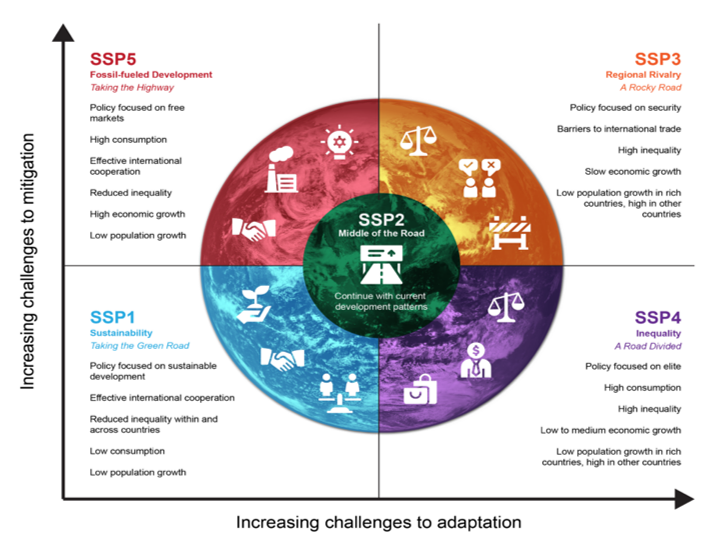
Figure 1: Summary of the five SSPs and what challenges they represent.
Source: Climate Data Canada, based on work by O’Neill et al., 2014
The storylines now used are called the Shared Socio-Economic Pathways. These were designed to be complementary to the RCPs but add potential human developments, inequalities, and future policy. For example, SSP1, which tells a story of a sustainable world with human development and net zero emissions, correlates with the greenhouse gas level of RCP2.6. The IPCC uses this combination of pathways as the basis for its Sixth report, and we believe it will continue this in the seventh report.
The Current Cycle.
The different modelling systems and pathways are complex, but they are the result of millions of results being collected together, compared, and tested. They help to distinguish what changes will be highly likely, or unlikely based on different levels of warming. For example, the IPCC AR6 assess that with a baseline of SSP3-7.0 and SSP5-8.5 it is virtually certain that within this century, the Arctic Ocean will be ice free once a year.To give another example, warming by 1.5°C by 2040 was only relatively likely to occur under scenario SSP1-2.6. Knowing these outcomes helps policy makers plan under uncertainty.
The IPCC’s Assessment Report captures the current understanding of all climate data and models, and applies it to the world, from mitigation, adaptation, vulnerability to natural disasters, disease, volcanoes and tipping points.
Recently this understanding has evolved: the CMIP7 has expressed that they will no longer use SSP5-8.5 - and we can expect that the IPCC AR7 will likely follow.
What Does RCP8.5 Mean?
The scenario SSP5 (correlating to RCP8.5) represents a storyline where the world continues to mine coal and oil at colossal scale and pursues a fossil fuel-based development. In this storyline the world would be around 4.5°C hotter by 2100 – we would see massive biodiversity loss, migration from new deserts, population growth and illness.
When the RCPs were created in the 2000s, global emissions were skyrocketing, coal production was still increasing, and renewable energy was developing slowly, so this did seem like a possible future outcome.. Researchers argued that ‘business as usual’ at that time would likely lead to 4-5 degrees of warming by 2100. But even in that context, RCP8.5 was a worst-case scenario, the high end of the data available at the time.
Retiring 8.5.
By the late 2010s, RCP8.5 was already gaining criticism. SSP5-8.5 assumes a level of increase in coal and fossil fuel emissions which is practically impossible today. Essentially, the world has made too much progress for the worst case emissions scenario to be plausible. Coal production has diminished hugely in the last 25 years. In 2025, the International Energy Agency reported that all new electricity generation was met by renewable sources, and there were huge advances in wind and solar. Rapid declines in energy costs have bent the curve of future emissions.

Figure 2: These estimates were made based on data from 2000. RCP8.5 uses levels of coal not compatible with today’s energy policies.
Source: van Vuuren et al., 2011
Therefore, in April 2026, the researchers of CMIP7 officially declared that RCP8.5 would be ‘implausible’ with today’s policy landscape. New assessments of current policies and net zero targets would suggest that 21st century warming could stay below 3.5°C. This still could be catastrophic, but we should not dismiss the progress that we have made in the last 20 years.
The Role of Associations.
Most importantly, the growing implausibility of the worst-case climate scenario demonstrates that coordinated climate policy, industry action, and long-term investment in decarbonisation are having a measurable impact. But we are still on track for a rapidly warming world, so action has never been more important.
Associations and membership bodies have a crucial role to play in continuing this positive momentum. Many organisations may still face challenges in understanding climate targets, emissions reporting and decarbonisation options. By providing guidance, sector-specific resources, training, and policy advocacy, they can help members navigate the net zero transition, and identify opportunities for innovation.
Climate Action for Associations (CAFA) offers free resources, workshops and sector-specific support to guide membership bodies. If your organisation would like to help mitigate the worst-case scenarios, you can join CAFA today and join a growing network driving practical climate action.


Comments